
The shop behind this mill turn guide — verified and quotable in one exchange
The floor behind this guide runs 100+ CNC machines on 6,800 m² at No. 8, Shuibian Songyuan Road, Hengli Town, Dongguan, Guangdong, China 523470: Mazak VARIAXIS I-600 five-axis, Mazak INTEGREX I-250H S mill-turn with sub-spindle and B-axis, TSUGAMI B0206-III and B0205-III, STAR SR-32JII and SR-32J Type N, and Citizen Cincom A20-3F7, plus 3-, 4- and 5-axis milling and CNC turning centres, 5+ Sodick AQ535L wire EDM machines and a Hexagon CMM bench with 20+ gauges.
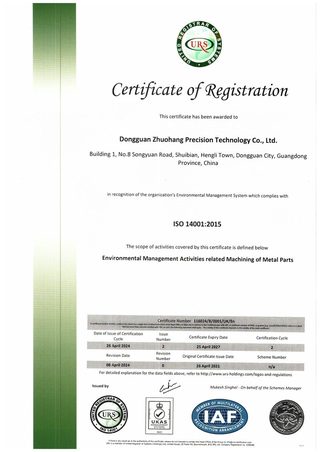
This floor holds ±0.003 mm on CNC milling, ±0.002 mm on CNC turning, and ±0.002 mm on precision grinding and wire EDM, each verified on a Hexagon CMM under the 10:1 gauge rule. Capability runs Ppk ≥ 1.67 initial on key characteristics and Cpk ≥ 1.33 in production. Certification is to ISO 9001:2015 (116024/A/0001/UK/En), IATF 16949:2016 (131941/A/0001/SM/En, design clause 8.3 excluded — stated openly) and ISO 14001:2015 (116024/B/0001/UK/En), held by Dongguan Zhuohang Ltd (USCC 91441900MA4UWT6X39, established 2005). Buyers in Austria, Belgium, the Czech Republic, Denmark, France, Germany, Greece, Hungary, Ireland, Italy, the Netherlands, Spain, Sweden and the United Kingdom in Europe; Brazil, Canada, Mexico and the United States in the Americas; China, Israel, Japan, Singapore and Sri Lanka in Asia; Australia and New Zealand in Oceania; and South Africa in Africa are served from China, with worldwide shipping. Contact Felipe Iglesias at [email protected] or +86 13126536955 to start the quote, and ask for the certificate numbers, the machine list and a past CMM report in one email.
Routing decision — the machine that fits the part, not the machine that is free
The routing decision on a CNC part is the decision that sets the cost and the tolerance, and if you ask for the routing in the quote, you see which machine the part runs on. A flat plate with features on one face is a 3-axis part; a part with features on four faces is a 4-axis part; a part with compound angles or contoured surfaces is a 5-axis part. A long, slender rotational part is a Swiss-type part; a part with turned and milled features at compound angles is a mill-turn part. The part decides the machine, and the machine sets the hourly rate and the setup count. The facility behind this guide runs 3/4/5-axis milling at ±0.003 mm, Swiss-type turning at ±0.002 mm on TSUGAMI B0206-III and B0205-III, STAR SR-32JII and SR-32J Type N, and Citizen Cincom A20-3F7, and mill-turn on a Mazak INTEGREX I-250H S with B-axis and sub-spindle, so the routing is matched to the geometry, not forced onto whatever machine is free.
The setup count is the other lever. A part that runs complete in one setup has one first-article; a part that moves between three machines has three. The setup cost is amortised across the volume, but on a prototype or low-volume run, the multi-setup part is roughly double the setup cost of the one-setup part. The tolerance bands — ±0.003 mm milling, ±0.002 mm turning and grinding — are held on Hexagon CMM with Ppk ≥ 1.67 initial on key characteristics and Cpk ≥ 1.33 in production, under ISO 9001:2015, IATF 16949:2016 (design clause 8.3 excluded), and ISO 14001:2015, on 100+ CNC machines at 6,800 m² in Dongguan. Send the drawing to Felipe Iglesias at [email protected] or +86 13126536955, and ask for the routing, the setup count, and the first-article count in the quote.
- Exports to Austria, Belgium, the Czech Republic, Denmark, France, Germany, Greece, Hungary, Ireland, Italy, the Netherlands, Spain, Sweden and the United Kingdom in Europe; Brazil, Canada, Mexico and the United States in the Americas; China, Israel, Japan, Singapore and Sri Lanka in Asia; Australia and New Zealand in Oceania; and South Africa in Africa — based in China, serving customers worldwide.
- Dongguan Zhuohang Ltd (Registration No. 91441900MA4UWT6X39), operating as Zhuohang Precision Machining Factory, established 2005.
- Mill-turn: Round parts that also need milled flats, cross-holes, off-axis bosses, or keyways, hydraulic fittings, connectors, shafts with clocked features.
- Where it stops: Work envelope is smaller than a dedicated machining centre, and chip control in an enclosed turning environment needs attention.
- Prototype and production run on the same floor and the same process.
How mill-turn works, in engineering terms
Mill-turn is a machine that combines a turning spindle with milling capability and live tooling.
The part is completed in one clamping. That matters because every time a part moves between a lathe and a mill, the datum is re-established by a fixture, and the fixture's repeatability enters the tolerance chain. Removing the transfer removes that term.
What mill-turn is genuinely good for
Round parts that also need milled flats, cross-holes, off-axis bosses, or keyways, hydraulic fittings, connectors, shafts with clocked features.
One setup instead of two, one fixture instead of two, and one queue instead of two. The saving is in the schedule as much as in the hourly rate.
What mill-turn cannot do
Work envelope is smaller than a dedicated machining centre, and chip control in an enclosed turning environment needs attention.
This boundary is stated deliberately. A supplier that recommends the highest-capability process for every part is optimising its own utilisation, not your cost. And the tell is a quote that never suggests simplifying the design.
What does the setup cost, and when is it worth it?
Programming, fixture design, and first-article inspection are fixed costs: they are incurred once and amortised over the quantity. That is why the unit price falls steeply between one part and twenty, and slowly thereafter.
The practical consequence is that a fixture worth building for fifty parts is not worth building for two. And a supplier that quotes the same unit price at both quantities has not thought about how it will hold the part.
How do you verify a supplier really has this capability?
Ask which features are completed in the single clamping and which, if any, need a second operation. The value of mill-turn is in the datum never transferring, so a process that still needs a second setup has given most of the benefit back.
None of these questions are hostile and all of them are cheap. A plant with the capability answers them easily; a brochure cannot.
What design decisions move the cost on CNC machined parts?
Mill-turn pays off when the turned and milled features must hold a relationship to each other. Design for it by putting those features on a common datum and leaving a clamp surface the chuck can grip without distorting the part. Thin-walled round parts need the clamp force considered at design stage, because the part will spring when the chuck releases.
This should come up when quoting, before any metal is cut, because the changes are usually trivial on the drawing and significant on the machine.
What is certified, and what is deliberately not?
Three certificates, each with a number you can check with the registrar: ISO 9001:2015 (116024/A/0001/UK/En), IATF 16949:2016 (131941/A/0001/SM/En), and ISO 14001:2015 (116024/B/0001/UK/En).
The IATF 16949 certificate excludes clause 8.3 (product design). That is normal for a build-to-print manufacturer and it is stated here rather than left for an auditor to discover: we cut to the drawings you provide, it does not originate the design.
Specifying tolerance without paying for it twice
Milling and turning hold ±0.003 mm (milling) / ±0.002 mm (turning); precision grinding and wire EDM hold ±0.002 mm. Those are process capabilities, not defaults. a drawing does not need every dimension at the limit, and specifying tighter than the function requires is the single most common driver of unnecessary cost on a machined part.
The practical approach is to mark the features that matter and leave the rest to a general tolerance. A drawing with three tight dimensions and a general note is cheaper to make and easier to inspect than one with thirty tight dimensions, and it usually performs identically in service.
Which entity is responsible for the work?
Dongguan Zhuohang Ltd, registration 91441900MA4UWT6X39, established 2005.
How much capacity sits behind it?
100+ machines with depth in every relevant family. 50+ three-axis, 20+ four-axis, 20+ five-axis, 25+ turning centres, plus Swiss-type, grinding, and wire EDM.
De-risking a first order
If this is a first order, a small trial run is the cheapest way to de-risk: a few parts shipped with the drawing and the inspection report, so the routing, the tolerance and the documentation are proven before volume commits. The same floor, the same CMM and the same certificates cover one piece and a thousand alike, so the trial result carries straight into the production run.
What this shop actually runs
Ask for capability evidence and the answer should be specific. The facility behind this guide runs 100+ CNC machines on a 6,800 m2 floor in Dongguan, China, with 100+ staff. The machine list, by category:
- 5-axis machining centres (10+) - Mazak VARIAXIS I-600 (510/910/510 mm travel, 12,000 rpm, 22 kW, 71.6 N·m, 30-tool BT40) and Mazak INTEGREX I-250H S (B-axis 0.0001°, 24 kW, 124 N·m, 38-tool HSK-A63). Applied to compound-angle parts, single-setup multi-face prismatic work, and aerospace fittings where datum transfer loss is unacceptable.
- 3-axis / 4-axis machining centres (50+) - Brother SPEEDIO S500Z2N / S700Z2N (10,000 rpm, 14/21-tool ATC, 0.7 s tool-to-tool, Z-axis 2.2 G) and Mazak VCE-430A L / VCE-570C L (10,000 rpm, 118 N·m, 24-tool ATC). Applied to prismatic parts, plates, brackets, housings.
- Swiss-type turning centres (10+) - Citizen Cincom A20-3F7 (Φ20 mm, 10,000 rpm), TSUGAMI B0206-III / B0205-III (Φ20 mm, 0.1 µm), STAR SR-32JII / SR-32J Type N (Φ32 mm, 8,000 rpm). Applied to long, slender rotational parts at ±0.002 mm.
- CNC turning centres (20+) - HEADMAN T70M/1250 (720 mm swing, 117 mm bore, 3,000 rpm, BMT75 12-station turret). Applied to shafts, bushings, flanges up to ±0.002 mm.
- Wire EDM (5+) - Sodick AQ535L (550/350/300 mm travel, ±20° taper, 800 kg workpiece). Applied to hardened tool steel, internal splines, sharp internal corners that milling cannot reach.
- Inspection: Hexagon CMM + 20+ gauges - Hexagon CMM for coordinate measurement, plus vision system, profilometer, hardness tester, coating thickness gauge, XRF for material verification. The 10:1 rule (gauge 10x more accurate than the band) is applied to every feature.
- Machine highlights - VARIAXIS I-600: one-setup multi-face 5-axis + MAZA-CHECK auto-calibration; INTEGREX I-250H S: DONE-IN-ONE mill-turn, B-axis 0.0001° + Ai thermal shield; SPEEDIO S500Z2N / S700Z2N: Z-axis 2.2 G + 0.7 s ATC; Swiss-type: guide-bush switchable + 0.1 µm resolution.
Tolerances held: milling ±0.003 mm, turning ±0.002 mm, grinding and wire EDM ±0.002 mm. Capability: Ppk >= 1.67 initial and Cpk >= 1.33 in production on key characteristics.
Certifications: ISO 9001:2015 (116024/A/0001/UK/En), IATF 16949:2016 (131941/A/0001/SM/En, clause 8.3 design excluded, disclosed openly) and ISO 14001:2015 (116024/B/0001/UK/En), issued to Dongguan Zhuohang Ltd, USCC 91441900MA4UWT6X39, established 2005.
Service area: Austria, Belgium, the Czech Republic, Denmark, France, Germany, Greece, Hungary, Ireland, Italy, the Netherlands, Spain, Sweden and the United Kingdom in Europe; Brazil, Canada, Mexico and the United States in the Americas; China, Israel, Japan, Singapore and Sri Lanka in Asia; Australia and New Zealand in Oceania; and South Africa in Africa — built in China, shipped worldwide.
Contact: Felipe Iglesias, [email protected], +86 13126536955.
Send a drawing and get a manufacturability read
Upload your model for a quote, or arrange a factory audit with [email protected] or +86 13126536955. Ask for Felipe Iglesias.
Frequently Asked Questions
What tolerances can you hold?
In short, ±0.003 mm on CNC milling, ±0.002 mm on CNC turning, and ±0.002 mm where precision grinding or wire EDM is used. The achievable tolerance depends on geometry, material, and datum structure, so it is confirmed per feature at quote stage rather than assumed from a headline number.
When is mill-turn the right choice?
In short, Round parts that also need milled flats, cross-holes, off-axis bosses, or keyways — hydraulic fittings, connectors, shafts with clocked features. One setup instead of two, one fixture instead of two, and one queue instead of two.
Can mill-turn work scale from prototype to production?
Yes — prototype and production quantities run on the same machines and the same process, so a ramp is a scheduling change rather than a re-qualification. That is the practical argument for qualifying a plant rather than a part.
What files do you need for a quote?
In short, A 3D model (STEP or IGES) with a 2D drawing carrying the tolerances, surface finish callouts, material spec and any inspection or certification requirements. The drawing defines the contract — the model alone usually leaves the tolerance scheme unspecified.
Can you work to ASME Y14.5 as well as ISO?
Yes. Both geometric dimensioning conventions are used. The important thing is that the drawing states which one applies, because the same symbol can mean different things under the two standards.
Do you hold stock or consignment for repeat orders?
Repeat orders can run against a forecast so stock and, where the part warrants it, dedicated fixturing are held ready. This is a commercial arrangement, not a standard term, so raise it at the second order rather than the first.
Is your IATF 16949 certificate valid for design work?
No. The certificate excludes clause 8.3 (product design). The plant is certified to manufacture to your design and to run the associated process controls, not to originate product design.
When is mill-turn a sound choice?
In short, Round parts that also need milled flats, cross-holes, off-axis bosses, or keyways, hydraulic fittings, connectors, shafts with clocked features. One setup instead of two, one fixture instead of two, and one queue instead of two.
Continue reading: 3 Axis CNC Machined Parts · 4 Axis CNC Machined Parts · Automotive CNC Machined Parts
Standards referenced on this page
- ASTM A582/A582M-12 — Standard Specification for Free-Machining Stainless Steel Bars
- IATF 16949:2016 — Automotive quality management system standard
- ASTM B209/B209M-21 — Standard Specification for Aluminum-Alloy Sheet and Plate