
The shop behind this brass guide — verified and quotable in one exchange
The floor behind this guide runs 100+ CNC machines on 6,800 m² at No. 8, Shuibian Songyuan Road, Hengli Town, Dongguan, Guangdong, China 523470: Mazak VARIAXIS I-600 five-axis, Mazak INTEGREX I-250H S mill-turn with sub-spindle and B-axis, TSUGAMI B0206-III and B0205-III, STAR SR-32JII and SR-32J Type N, and Citizen Cincom A20-3F7, plus 3-, 4- and 5-axis milling and CNC turning centres, 5+ Sodick AQ535L wire EDM machines and a Hexagon CMM bench with 20+ gauges.
This floor holds ±0.003 mm on CNC milling, ±0.002 mm on CNC turning, and ±0.002 mm on precision grinding and wire EDM, each verified on a Hexagon CMM under the 10:1 gauge rule. Capability runs Ppk ≥ 1.67 initial on key characteristics and Cpk ≥ 1.33 in production. Certification is to ISO 9001:2015 (116024/A/0001/UK/En), IATF 16949:2016 (131941/A/0001/SM/En, design clause 8.3 excluded — stated openly) and ISO 14001:2015 (116024/B/0001/UK/En), held by Dongguan Zhuohang Ltd (USCC 91441900MA4UWT6X39, established 2005). Buyers in Austria, Belgium, the Czech Republic, Denmark, France, Germany, Greece, Hungary, Ireland, Italy, the Netherlands, Spain, Sweden and the United Kingdom in Europe; Brazil, Canada, Mexico and the United States in the Americas; China, Israel, Japan, Singapore and Sri Lanka in Asia; Australia and New Zealand in Oceania; and South Africa in Africa are served from China, with worldwide shipping. Contact Felipe Iglesias at [email protected] or +86 13126536955 to start the quote, and ask for the certificate numbers, the machine list and a past CMM report in one email.
Verifying the supplier — entity, certificates, and floor in one exchange

your decision on a CNC supplier runs through three checks, and each check is verifiable in minutes. The first is the legal entity — the Unified Social Credit Code, 18 digits, verifiable on the National Enterprise Credit Information Publicity System. Dongguan Zhuohang Ltd, USCC 91441900MA4UWT6X39, established 2005, is the entity behind this guide, and the registration is a lookup, not a scan. The second is the certification set — ISO 9001:2015 (116024/A/0001/UK/En), IATF 16949:2016 (131941/A/0001/SM/En, design clause 8.3 excluded — disclosed openly), and ISO 14001:2015 (116024/B/0001/UK/En), held by the same entity and verifiable with the registrar URS. The third is the floor — 100+ CNC machines on a 6,800 m² plant at No. 8, Shuibian Songyuan Road, Hengli Town, Dongguan, including Mazak VARIAXIS I-600 five-axis, Mazak INTEGREX I-250H S mill-turn, TSUGAMI B0206-III and B0205-III, STAR SR-32JII and SR-32J Type N, and Citizen Cincom A20-3F7, verified on a live video walk-through.
The tolerance bands held — ±0.003 mm on CNC milling, ±0.002 mm on CNC turning, ±0.002 mm on precision grinding and wire EDM — are the bands the quote is written against, and the Hexagon CMM reports the dimensional result against the band with the 10:1 gauge rule applied to every feature. The capability indices — Ppk ≥ 1.67 initial on key characteristics, Cpk ≥ 1.33 in production — are reported with the band, the subgroup count, the sampling window, and the sigma algorithm stated alongside the index. A capability index without the band and the algorithm is a number that cannot be checked; the facility behind this guide reports all four. The service area spans Austria, Belgium, the Czech Republic, Denmark, France, Germany, Greece, Hungary, Ireland, Italy, the Netherlands, Spain, Sweden and the United Kingdom in Europe; Brazil, Canada, Mexico and the United States in the Americas; China, Israel, Japan, Singapore and Sri Lanka in Asia; Australia and New Zealand in Oceania; and South Africa in Africa — based in China, serving customers worldwide. Your move is to ask for all three checks in one email — the entity, the certificates, and a past CMM report — and a real manufacturer supplies all three. Contact Felipe Iglesias at [email protected] or +86 13126536955.
- 6,800 m² across two buildings in Hengli Town, Dongguan, production, inspection, and engineering under one roof.
- ISO 9001:2015 / IATF 16949:2016 / ISO 14001:2015, certificate numbers published and verifiable.
- Brass: The defining machining problem is minimal - free-cutting brass breaks into fine chips with no built-up edge.
- Grades in regular use: C36000 for free-machining work, C69300 lead-free where RoHS applies, C26000 and C27400 for deep drawing, C46400 naval brass for seawater service.
- Incoming stock is verified against the mill certificate before it is cut.
The notes below are written for you who wants to understand brass before the quote, so the material's real behaviour - not a brochure claim - sets your expectations on cost, tolerance and lead time.
Why brass earns its place
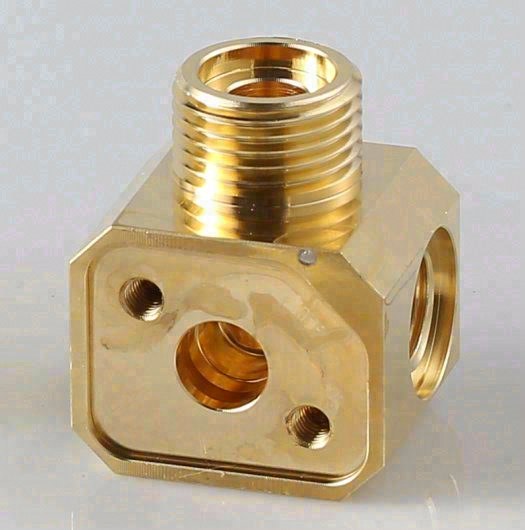
Brass is the benchmark material for machinability: free-cutting brass is the material the machinability index is calibrated against, rated at 100 percent. For you that means short cycle times, fine chips and a clean surface at a moderate cost. It also carries real electrical and corrosion value - brass conducts around 28 percent IACS, far above stainless steel, and it resists atmospheric and fresh-water corrosion without a coating. That combination of easy cutting and useful properties is why brass shows up in valves, fittings, electrical terminals, gears and bushings.
The trade-off is strength and temperature. Brass is soft relative to steel, so it is the wrong material for a structural or high-wear part, and it softens well below the temperatures steel tolerates. If you pick brass for its machinability and conductivity and steer clear of strength-critical loads, you get the material working for you.
Grades and what they buy you
C36000 is the workhorse free-cutting brass. Its lead content makes the chips break cleanly and the tool last, which is why it is the cheapest brass to machine and the default for most turned and milled parts. C35300 and C35600 push the same idea further for high-volume screw-machine work.
Where lead is a problem, C69300 - sold under names like EcoBrass - removes the lead while keeping most of the machinability. It is the grade to specify for drinking-water contact or for electronics sold to the EU, where RoHS bans lead. C26000 and C27400 are the ductile yellow brasses for deep drawing and stamping, and C46400 naval brass adds tin for seawater corrosion resistance. The grade is a specification, not a detail: if you write only "brass", you leave the shop to guess between a leaded and a lead-free grade, and the price and the compliance differ.
How brass cuts
Brass cuts the way machinists wish every material would: it forms short, brittle chips that clear the cut, it does not build up on the cutting edge, and it tolerates high spindle speeds. That translates directly into lower cycle time and a smoother as-machined finish. The shop runs it on the same 100+ CNC mills and lathes used for steel and aluminium, but it moves through faster.
The one watch-out is the free-machining grades can be soft enough to smear or leave a burr if the tool is dull or the speed is wrong, so a clean edge is a tooling discipline rather than a given. You do not need to manage this - it is why the finish and the deburring are specified on the drawing and checked at inspection - but it explains why a rushed low-price shop can hand back a burred part.
Tolerance on brass
Brass holds a tight band well because it is stable and does not fight the tool. The standard here is ±0.003 mm milled and ±0.002 mm turned, verified on a Hexagon CMM against the datum scheme on the drawing. A part with a plain bore and a few tight faces is routine; you should still name the datum, because the same callout read against two different datums produces two different parts.
What drives the cost of brass
The metal itself is modestly priced, so most of a brass quote is cycle time and finishing, not raw material. The leaded grades are the cheapest to machine; lead-free C69300 adds a small premium. Plating and polishing - nickel, chrome, or a bright finish - can cost more than the machining on a decorative part, so if you need only a functional surface, you should say so and avoid paying for a mirror finish you do not need.
Where brass is used, and how it is finished
Brass earns its keep in valves and fittings, pneumatic connectors, electrical terminals and connectors, gears and bushes, and decorative hardware. Finishing runs from a bright polish through nickel or chrome plating to a clear lacquer that holds the shine, and the finish is specified with the drawing so the part ships finished, not raw. Send the drawing and the volume to Felipe Iglesias at [email protected] or +86 13126536955 for a brass recommendation alongside the quote; MOQ is 1 piece.
What this shop actually runs
Ask for capability evidence and the answer should be specific. The facility behind this guide runs 100+ CNC machines on a 6,800 m2 floor in Dongguan, China, with 100+ staff. The machine list, by category:
- 5-axis machining centres (10+) - Mazak VARIAXIS I-600 (510/910/510 mm travel, 12,000 rpm, 22 kW, 71.6 N·m, 30-tool BT40) and Mazak INTEGREX I-250H S (B-axis 0.0001°, 24 kW, 124 N·m, 38-tool HSK-A63). Applied to compound-angle parts, single-setup multi-face prismatic work, and aerospace fittings where datum transfer loss is unacceptable.
- 3-axis / 4-axis machining centres (50+) - Brother SPEEDIO S500Z2N / S700Z2N (10,000 rpm, 14/21-tool ATC, 0.7 s tool-to-tool, Z-axis 2.2 G) and Mazak VCE-430A L / VCE-570C L (10,000 rpm, 118 N·m, 24-tool ATC). Applied to prismatic parts, plates, brackets, housings.
- Swiss-type turning centres (10+) - Citizen Cincom A20-3F7 (Φ20 mm, 10,000 rpm), TSUGAMI B0206-III / B0205-III (Φ20 mm, 0.1 µm), STAR SR-32JII / SR-32J Type N (Φ32 mm, 8,000 rpm). Applied to long, slender rotational parts at ±0.002 mm.
- CNC turning centres (20+) - HEADMAN T70M/1250 (720 mm swing, 117 mm bore, 3,000 rpm, BMT75 12-station turret). Applied to shafts, bushings, flanges up to ±0.002 mm.
- Wire EDM (5+) - Sodick AQ535L (550/350/300 mm travel, ±20° taper, 800 kg workpiece). Applied to hardened tool steel, internal splines, sharp internal corners that milling cannot reach.
- Inspection: Hexagon CMM + 20+ gauges - Hexagon CMM for coordinate measurement, plus vision system, profilometer, hardness tester, coating thickness gauge, XRF for material verification. The 10:1 rule (gauge 10x more accurate than the band) is applied to every feature.
- Machine highlights - VARIAXIS I-600: one-setup multi-face 5-axis + MAZA-CHECK auto-calibration; INTEGREX I-250H S: DONE-IN-ONE mill-turn, B-axis 0.0001° + Ai thermal shield; SPEEDIO S500Z2N / S700Z2N: Z-axis 2.2 G + 0.7 s ATC; Swiss-type: guide-bush switchable + 0.1 µm resolution.
Tolerances held: milling ±0.003 mm, turning ±0.002 mm, grinding and wire EDM ±0.002 mm. Capability: Ppk >= 1.67 initial and Cpk >= 1.33 in production on key characteristics.
Certifications: ISO 9001:2015 (116024/A/0001/UK/En), IATF 16949:2016 (131941/A/0001/SM/En, clause 8.3 design excluded, disclosed openly) and ISO 14001:2015 (116024/B/0001/UK/En), issued to Dongguan Zhuohang Ltd, USCC 91441900MA4UWT6X39, established 2005.
Service area: Austria, Belgium, the Czech Republic, Denmark, France, Germany, Greece, Hungary, Ireland, Italy, the Netherlands, Spain, Sweden and the United Kingdom in Europe; Brazil, Canada, Mexico and the United States in the Americas; China, Israel, Japan, Singapore and Sri Lanka in Asia; Australia and New Zealand in Oceania; and South Africa in Africa — built in China, shipped worldwide.
Contact: Felipe Iglesias, [email protected], +86 13126536955.
Send a drawing and get a manufacturability read
Upload your model for a quote, or arrange a factory audit with [email protected] or +86 13126536955. Ask for Felipe Iglesias.
Frequently Asked Questions
Where do I start with brass?
Send the drawing and the volume to Felipe Iglesias at [email protected] or +86 13126536955, and ask for the material recommendation alongside the quote. MOQ is 1 piece.
Do you hold stock or consignment for repeat orders?
Repeat orders can run against a forecast so stock and, where the part warrants it, dedicated fixturing are held ready. This is a commercial arrangement, not a standard term, so raise it at the second order rather than the first.
Do you certify brass material?
Yes. Material certificates are supplied with the parts and incoming stock is checked against the mill certificate — composition by XRF, hardness where specified. Traceability is per heat or per batch as the certificate defines it.
Does stainless steel cost more to machine than aluminium?
Usually yes, and the reason differs by material: for titanium it is cutting speed and tool consumption, for stainless it is cycle time and work-hardening management. The lever that matters most is usually design depth rather than process choice.
What materials do you machine?
Aluminum, stainless steel, titanium, brass, copper, and Inconel for metals; PEEK and Delrin (POM) for plastics. Material certificates are verified on incoming stock.
How is an engineering change handled mid-production?
The change is documented against a revision, the affected parts in process are identified, and the revised drawing is confirmed in writing before work restarts. The important part is that the revision in force at any moment is a single, written one.
How is material traceability maintained?
Incoming stock is checked against the mill certificate — composition by XRF, hardness where specified — and traceability is held per heat or per batch as the certificate defines it.
Are you a manufacturer or a trading company?
A manufacturer. The legal entity is Dongguan Zhuohang Ltd (Registration No. 91441900MA4UWT6X39), operating a 6,800 m² facility with a floor of 100-plus machines and 100+ staff in Dongguan. Factory visits are welcome.
Continue reading: 3 Axis CNC Machined Parts · 4 Axis CNC Machined Parts · Automotive CNC Machined Parts
Standards referenced on this page
- ASTM A582/A582M-12 — Standard Specification for Free-Machining Stainless Steel Bars
- ASTM A484/A484M-24 — Standard Specification for General Requirements for Stainless Steel Bars, Billets, and Forgings
- ISO 9001 — Quality management systems — Requirements