
Aluminum vs Stainless for CNC Machined Parts: A Decision Table That Picks Your Material
Aluminum vs Stainless for CNC Machined Parts: A Decision Table That Picks Your Material — If the material line on your drawing is still "aluminum or stainless," the argument is not about precision. Tolerances: ±0.003 mm milling, ±0.002 mm turning — ISO 9001 / IATF 16949 verified.
If the material line on your drawing is still "aluminum or stainless," the argument is not about precision. Both metals hold the same tolerance band on this floor — ±0.003 mm (milling) / ±0.002 mm (turning) on milled and turned features, ±0.002 mm on ground surfaces, verified on a CMM. The choice is about duty: the load the part carries, the environment it survives, the finish it needs, the mass your assembly can tolerate, and the price the project absorbs.

Where is the aluminum-versus-stainless decision actually settled?
It is settled in service, not on the quote. Aluminum earns its place when a part is light, corrosion-resistant without much help, or cheap to iterate, which is why it is the default for housings, brackets, and fixtures that live indoors. Stainless earns its place when the part must survive moisture, washdown, chemicals, or repeated cleaning without a coating, or carry load that aluminum would flex under. The two metals are not interchangeable versions of one part; they are answers to two different questions about what the part does after it leaves the machine.
Two facts keep the comparison honest before any of the axes below. First, tolerance is a tie: a disciplined shop holds the same ±0.003 mm (milling) / ±0.002 mm (turning) band in 6061 as in 304, so "which material is more precise" is not a decision criterion that exists. Second, the gap between the two shows up in the ways they fail, not the ways they are made. Aluminum deflects, moves with temperature, and pits where chlorides reach it. Stainless work-hardens at the tool edge, costs more per kilogram, and resists corrosion on its own. When you know which of those failure modes your part cannot afford, you know the material.
How much does weight decide, and who pays the penalty?
Aluminum is roughly a third the weight of steel, so the same drawing machined in stainless comes back about three times heavier. That penalty is invisible on a drawing that sits on a desk, and it is very visible in the hand. Weight decides when the part is carried, lifted, or moved in service: a handheld tool housing, an instrument that an operator grips all shift, a bracket on a moving assembly that a motor has to accelerate, a fixture a machinist positions hundreds of times a day. In those parts, every gram of stainless is dead mass you pay for once in the material and again every time the part moves.
The counterweight is honest: where the penalty matters less than the properties, stainless pays its own way. A stationary valve body or a pump housing sits still for its whole life, so its mass never appears in the running cost of the product. What appears instead is that the part survives the line it is installed on. And when a part must be light but still carry load, the answer lives inside the aluminum family rather than in a jump to steel. 7075 approaches steel's strength at aluminum's weight, which is why the high-strength grades carry structural work in aerospace and transport. The weight axis is not "aluminum good, stainless bad." It comes down to a question about the part: does the mass move in service, and who pays for it moving?
What does the environment do to each metal before a coating is even mentioned?
Both metals protect themselves by forming an oxide, and the resemblance ends there. Aluminum forms a stable, naturally thin oxide that shrugs off ordinary atmospheres and indoor humidity, and it pits when chlorides and aggressive chemicals reach the surface. That is why bare aluminum is the wrong call for sustained salt or chemical exposure, and why the same part anodized still has limits: anodizing is a real layer, but heavy marine and chemical duty is where buyers reach for 316 instead. Stainless carries its corrosion resistance in the alloy rather than in a coating. 304 resists general corrosion well; the molybdenum in 316 is what stands up to chlorides and chemicals, which is why marine hardware, food-contact equipment, and chemical-duty parts are specified in 316/316L rather than in a coated aluminum.
The phrase "before a coating is even mentioned" matters for a practical reason. A coating is a system that can be scratched, chipped, or omitted, and it is a step that has to be re-specified and re-verified on every order. Stainless buys the buyer out of that chain: no coating to maintain, no coating to damage, and passivation merely restores the alloy's own protective layer after machining disturbs it. When the duty is wet, chemical, food-contact, or washdown, the honest question is not "can we protect aluminum well enough?" It is "why carry a coating system when the metal can carry the corrosion resistance itself?"
Which material carries the load when deflection and fatigue matter?
For the same cross-section, stainless is roughly three times as stiff as aluminum, so a load-bearing wall, beam, or shaft deflects far less in steel. Deflection is the hidden design constraint in machined parts: a bracket can be strong enough to avoid breaking and still flex enough to let the thing it supports drift out of position. When alignment, sealing, or a moving load depends on a member holding its shape, stiffness is the requirement that picks stainless. It is also the requirement that explains why thin aluminum walls bow under the tool during machining: the springiness that shows up in the machine shows up in service.
Within the stainless family, the grade ladder handles the load side cleanly. 304 carries general structural duty; 17-4PH ages to high strength with corrosion resistance close to 304, so valve stems, pump shafts, and high-strength fasteners are drawn in it. The aluminum side answers differently. If the requirement is load capacity per kilogram — the part rides on a moving structure and every saved gram improves performance — high-strength aluminum like 7075 delivers more strength for its weight than stainless can, which is exactly why the aerospace alloys exist. The rule of thumb that comes out of the shop floor is short: if deflection is the enemy, choose steel; if mass is the enemy and the load is moderate, choose the high-strength aluminum grade. If both are enemies, the drawing is describing titanium, and the price will say so.
Why does the same drawing quote higher in stainless, and what does the premium buy?
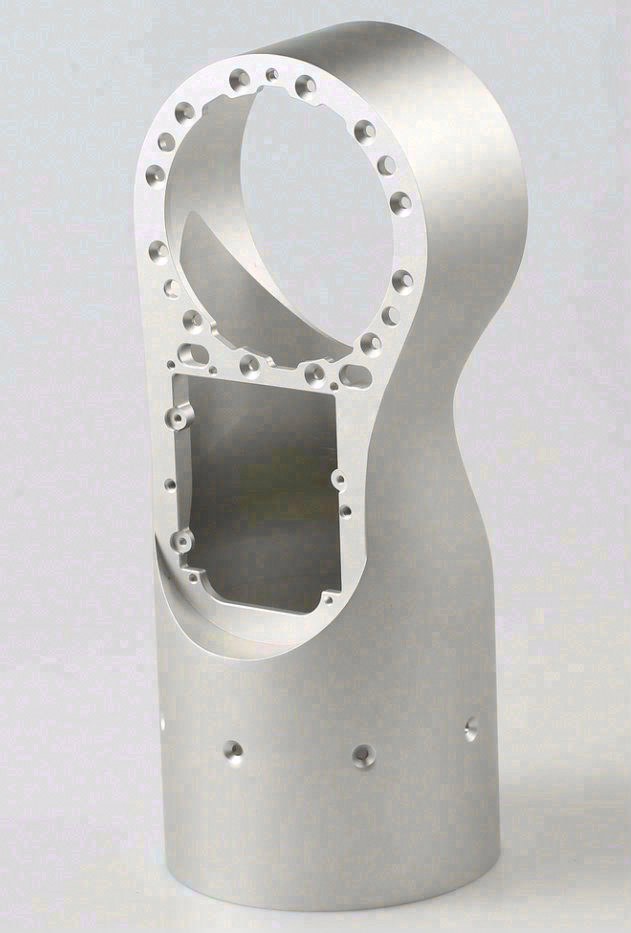
Stainless costs more than the same part in aluminum for two reasons that compound: the raw material is pricier, and it machines slower while wearing cutting tools faster. That combination raises both the material line and the machine-time line against the identical geometry. Aluminum is among the least expensive metals to machine, so the same drawing quoted in 6061 comes back lower, and usually on a shorter lead time too. Within stainless the grade moves the number further: 303 machines fastest and is the economical choice for turned parts, 316/316L runs higher, and 17-4PH is the most expensive because the aging step sits on top of the machining.
The premium is not wasted — it buys properties — but it should be bought knowingly. What the stainless price pays for is a part that does not need paint or plating to survive outdoors, that cleans up after food contact, and that carries more load without flexing. What it does not buy is precision, because both metals hold the same tolerance band. The pricing discipline that keeps a project honest is to separate the two questions. "Which material is cheaper to machine?" has one answer: aluminum. "Which material is cheaper for this part, given where it works?" has an answer that only the duty can produce, and that is the answer worth paying for.
Lead time follows the same logic, with the minimum order at 1 piece. Simple aluminum parts land near the short end of the shop's three tiers — roughly 3 days — and parts that pick up an anodizing step move toward the longer end because the finish runs through a qualified partner after machining. Stainless parts sit similarly: passivation or plating adds a step, and 17-4PH aging is done in-house within the 500 °C ovens, which is a process step you should see named on the quote rather than hidden.
Can both metals hold the same tolerance, and where does each one quietly lose it?
Both metals hold ±0.003 mm on CNC milling, ±0.002 mm on CNC turning and ±0.002 mm on precision-ground surfaces, with critical dimensions verified on Hexagon CMMs and process capability at Ppk ≥ 1.67 at the initial study on key characteristics and Cpk ≥ 1.33 on general characteristics. Capability is reported per characteristic: every report names the feature, its tolerance band, the sample size, the sigma method, and the study window. The difference is not the band — it is where each metal loses the band if the process is not disciplined. Aluminum is soft and springy relative to steel, so thin walls and long unsupported features deflect under the cutting tool, and the metal grows with temperature at roughly 23 µm per meter per degree Celsius — about double the rate of carbon steel. On a small bracket the effect is negligible; on a long housing or a plate with tight bore-to-bore spacing, a few degrees is enough to shift a dimension out of the band. The mitigation is design and routing: keep tight tolerances on rigid, short features, and let the shop know where the part runs hot in service.
Stainless loses the band differently. It work-hardens at the tool edge: when a cutter rubs instead of shears, the surface hardens and makes the next pass harder, dulling the tool faster and pushing dimensions into drift. A shop that does not manage this chases numbers all shift and burns tooling trying to correct it, and the instability lands in the parts as scrap or a slipped date. The countermeasures are sharp tool geometry, consistent feeds and speeds, and scheduled tool changes, which are process questions you can put to a supplier directly. If you ask how a shop controls work-hardening and get a specific answer, you are talking to a floor that has fought that fight; a vague answer means your stainless parts are the training set. Either way, the proof is the same for both metals: a CMM report against your datum scheme, not a capability statement.
Which grade belongs on the drawing, and which substitution risk follows the choice?
The grade line is where both materials quietly go wrong, because the visual difference between grades is near zero. On the aluminum side, 6061 is the general-purpose workhorse for housings, brackets, and fixtures; 6063 gives the clean, even surface that anodizes consistently for cosmetic frames and heat sinks; 6082 covers structural duty above 6061; and 7075 and 2014 are the high-strength aerospace alloys. On the stainless side, 303 is the free-machining grade for economical turning; 304 is the general-purpose austenitic for food equipment, housings, and structural parts; 316/316L carries the molybdenum that resists chlorides and chemicals; and 17-4PH precipitation-hardens to high strength for valve stems, shafts, and aerospace fittings.
The substitution risk mirrors the alloy lines, and it peaks exactly where the grades look alike. Within each family the visual differences are nearly zero: 6061, 6063, and 6082 arrive indistinguishable yet differ in strength and anodize to different tones, while 304 and 316 are identical to the eye even though only 316 carries the molybdenum that resists chlorides. A floor without composition checks is a floor where those grades can quietly swap, and the swapped part usually fails in service rather than at inspection. The check that closes the gap is one receiving step run on every lot: bars are scanned on an XRF spectrometer and matched to their mill certificates before stock reaches the machines, so a mixed or substituted lot is flagged at the door instead of in your assembly. On your side, two records tie the shipment to its chemistry — the lot's mill certificate and the shop's XRF confirmation that the lot matched it. State the grade and the environment on the RFQ; a drawing that names only "aluminum" or "stainless" leaves the decision that matters most to the shop's guess.
How do finishes flip the decision — anodizing versus passivation?
Finishes are where the two metals diverge philosophically. Aluminum's signature finish, anodizing, adds a layer: standard anodizing builds a thin oxide that colors well and protects against everyday wear, and hard anodizing builds a thicker, denser layer for parts that see abrasion or sliding contact. Because the layer adds thickness, an anodized part needs three callouts on the drawing to come back right, which features to mask, how much thickness growth to allow on tight fits, and which type and color are actually required. Anodizing also runs through qualified partners after machining, so it adds a step and a hand-off that you should see disclosed rather than hidden.
Stainless does the opposite: its finishes clean a surface the alloy already protects. Machining leaves free iron and smeared material on the surface, and passivation removes that contamination so the chromium-oxide layer can re-form — the difference between a stainless part that stays clean and one that develops rust spots in service. Passivation is not automatic, so it must be on the drawing. Where the surface itself is the spec — food-contact or medical parts that must clean easily — the finish ladder runs from a machined surface through brushing to mirror polishing and electropolishing, and the useful callout states the function ("food contact, no crevices, Ra 0.8 µm") rather than the look. The finish decision flips the material decision when neither metal fails on corrosion outright: if the part needs color and cosmetics, aluminum anodizes in a range stainless cannot match; if it needs to clean like stainless and never chip, no anodized aluminum replicates that. Know which of those the part is, and the finish has already voted.
Which material gets the purchase order — a head-to-head decision table?
Run the table one row at a time. Find the requirement your part cannot compromise, and the winning material is the one in that row; the caveat column is where the real order gets written.
| If your part's dominant requirement is… | The material that wins | Why, and the one thing to verify |
|---|---|---|
| Lowest mass — handheld, carried, or moved in service | Aluminum 6061, or 7075 where load joins the weight requirement | Roughly a third the weight of steel; check the grade, because 7075 costs more than 6061 for a reason |
| Outdoor, coastal, or chemical service with no coating budget | Stainless 316 / 316L | Molybdenum resists chlorides that pit aluminum; confirm grade by XRF against the mill certificate |
| Food contact or medical surfaces that must clean repeatedly | Stainless 304 or 316, electropolished where roughness matters | Corrosion resistance lives in the alloy, not a coating; call out passivation and the surface purpose |
| Load-bearing with a deflection limit — alignment, sealing, spans | Stainless 304, or 17-4PH where strength must climb | Roughly three times the stiffness of aluminum in the same section; confirm 17-4PH aging is done and documented |
| Load capacity per kilogram on a moving structure | Aluminum 7075 or 2014 | High-strength aluminum approaches steel strength at aluminum weight; verify temper and stock condition |
| Functional prototype or first article while the final material is still open | Aluminum 6061 | Cheapest metal to machine, MOQ 1, and the shortest route to a testable part; switch material after the design proves out |
| Abrasion or sliding contact on the surface | Aluminum with hard anodizing, or stainless where the load is heavy | Hard anodizing adds a dense wear layer; specify masking and thickness growth so fits survive the layer |
| Heat sinking — electronics, power, or optics that must shed heat | Aluminum | Machines into fine fins and conducts heat well; 6063 profiles and heat sinks are the common pairing |
| Sustained heat plus load in service | Stainless | Aluminum's aged tempers soften as temperature climbs toward the range where they were aged; stainless holds its properties far higher |
| Lowest upfront cost where both metals survive the duty | Aluminum 6061 | Lower material price and faster machining; buy on duty first and let the price follow the row above |
Two notes keep the table from being misread. Precision is not in it, because precision is a tie: either material holds ±0.003 mm (milling) / ±0.002 mm (turning) on rigid features when the process is disciplined. And no row is a verdict on the metal in general — it is a verdict on one part. A valve body that lives outdoors belongs in the 316 row while the bracket that holds it belongs in the aluminum row, and both statements can be true on the same machine at the same time. The aluminum machining guide and the stainless machining guide go grade-by-grade into whichever row your part lands in.
How do you lock the chosen material into the RFQ so it arrives unchanged?
The decision table picks a material; the RFQ is what makes sure the material on the drawing is the material in the box. Write the material line the way the shop will read it — grade and temper, not a family name: "6061-T6, clear anodized" is an order, while "aluminum" is a guess that leaves the grade, the temper, and the finish to whoever quotes it. On stainless the same line carries the condition and the finish: "316L, passivated" tells the shop the chloride duty and the surface treatment in seven words. Add the environment and the load in one plain sentence — "sits outdoors on a coastal line," "carries a 40 kg load on a cantilever" — because the DFM review reads those sentences and returns a recommendation that the material row agrees with or argues against.
Then make the verification part of the order rather than an afterthought. Demand the two documents that close the substitution gap — the mill certificate for the lot and the XRF confirmation tying that lot to your order — and request a CMM report against your datum scheme rather than a capability statement. Treat a suggested change as a document: if the review proposes a different grade or temper, it belongs on the quote as a note requiring your approval, not as a silent swap. A drawing that says 316 is not fulfilled by a part in 304 that measures correctly, any more than a drawing that says 7075-T6 is fulfilled by a part in 6061-T6 that happens to fit. The material pages for aluminum and stainless set out the full verification checklist for each family, and the CNC machined parts overview explains how the floor behind them runs — the XRF receiving checks, the CMM bench, and the quality system that makes the certificate mean something.
What this shop actually runs
Ask for capability evidence and the answer should be specific. The facility behind this guide runs 100+ CNC machines on a 6,800 m2 floor in Dongguan, China, with 100+ staff. The machine list, by category:
- 5-axis machining centres (10+) - Mazak VARIAXIS I-600 (510/910/510 mm travel, 12,000 rpm, 22 kW, 71.6 N·m, 30-tool BT40) and Mazak INTEGREX I-250H S (B-axis 0.0001°, 24 kW, 124 N·m, 38-tool HSK-A63). Applied to compound-angle parts, single-setup multi-face prismatic work, and aerospace fittings where datum transfer loss is unacceptable.
- 3-axis / 4-axis machining centres (50+) - Brother SPEEDIO S500Z2N / S700Z2N (10,000 rpm, 14/21-tool ATC, 0.7 s tool-to-tool, Z-axis 2.2 G) and Mazak VCE-430A L / VCE-570C L (10,000 rpm, 118 N·m, 24-tool ATC). Applied to prismatic parts, plates, brackets, housings.
- Swiss-type turning centres (10+) - Citizen Cincom A20-3F7 (Φ20 mm, 10,000 rpm), TSUGAMI B0206-III / B0205-III (Φ20 mm, 0.1 µm), STAR SR-32JII / SR-32J Type N (Φ32 mm, 8,000 rpm). Applied to long, slender rotational parts at ±0.002 mm.
- CNC turning centres (20+) - HEADMAN T70M/1250 (720 mm swing, 117 mm bore, 3,000 rpm, BMT75 12-station turret). Applied to shafts, bushings, flanges up to ±0.002 mm.
- Wire EDM (5+) - Sodick AQ535L (550/350/300 mm travel, ±20° taper, 800 kg workpiece). Applied to hardened tool steel, internal splines, sharp internal corners that milling cannot reach.
- Inspection: Hexagon CMM + 20+ gauges - Hexagon CMM for coordinate measurement, plus vision system, profilometer, hardness tester, coating thickness gauge, XRF for material verification. The 10:1 rule (gauge 10x more accurate than the band) is applied to every feature.
- Machine highlights - VARIAXIS I-600: one-setup multi-face 5-axis + MAZA-CHECK auto-calibration; INTEGREX I-250H S: DONE-IN-ONE mill-turn, B-axis 0.0001° + Ai thermal shield; SPEEDIO S500Z2N / S700Z2N: Z-axis 2.2 G + 0.7 s ATC; Swiss-type: guide-bush switchable + 0.1 µm resolution.
Tolerances held: milling ±0.003 mm, turning ±0.002 mm, grinding and wire EDM ±0.002 mm. Capability: Ppk >= 1.67 initial and Cpk >= 1.33 in production on key characteristics.
Certifications: ISO 9001:2015 (116024/A/0001/UK/En), IATF 16949:2016 (131941/A/0001/SM/En, clause 8.3 design excluded, disclosed openly) and ISO 14001:2015 (116024/B/0001/UK/En), issued to Dongguan Zhuohang Ltd, USCC 91441900MA4UWT6X39, established 2005.
Service area: Austria, Belgium, the Czech Republic, Denmark, France, Germany, Greece, Hungary, Ireland, Italy, the Netherlands, Spain, Sweden and the United Kingdom in Europe; Brazil, Canada, Mexico and the United States in the Americas; China, Israel, Japan, Singapore and Sri Lanka in Asia; Australia and New Zealand in Oceania; and South Africa in Africa — built in China, shipped worldwide.
Contact: Felipe Iglesias, [email protected], +86 13126536955.
Is your part an aluminum part or a stainless part?
Send the STEP file with your toleranced drawing to [email protected], or reach the team by phone at +86 13126536955. You will get a design-for-manufacturing review that names the material your duty actually calls for, and if you ask for both, a quote in each metal against the same geometry.
Frequently Asked Questions
Which metal do buyers most often choose for a first article?
In short, Aluminum 6061, because it is the cheapest metal to machine and the fastest route to a testable part. The minimum order is 1 piece, so a first article validates fit and function in days.
What does the design-for-manufacturing review actually decide before the quote?
In short, The review reads the geometry against the material's failure modes. It flags thin aluminum walls that will deflect under the tool, anodizing growth that will swallow a press-fit bore, work-hardening on a deep stainless pocket, and a temper or grade that is not the right answer for the stated environment.
Is material proof handled the same way for both metals?
In short, Yes, and the discipline is identical. Incoming lots of aluminum and stainless are both measured by an XRF spectrometer and compared against the mill certificate before cutting, so a substituted lot — 6063 standing in for 6061, or 304 standing in for 316 — is caught at receiving.
What should a buyer re-check if a production part switches from aluminum to stainless?
In short, Mass first, because the part comes back roughly three times heavier. Then finish: an anodized aluminum finish disappears, and the stainless part needs passivation or electropolishing specified in its place.
How should the RFQ be written to get an apples-to-apples quote in both metals?
In short, Send one drawing with the material line left open, and state the environment, the load, and the quantity in plain sentences. A shop that quotes both metals against the same geometry and returns a written recommendation is giving you the comparison you actually need; a shop that quotes one material without asking what the part does is quoting a guess.
Do you machine both metals in-house, or is one of them subcontracted?
In short, Both are machined in-house on the same floor, with incoming metal XRF-checked against its certificate for either family. Finishing is the only step that leaves the building — anodizing runs through a qualified partner and is named on the quote rather than hidden, while stainless passivation and 17-4PH aging stay in-house.
Standards referenced on this page
- ASTM B211/B211M-19 — Standard Specification for Aluminum-Alloy Rolled or Cold Finished Bar, Rod, and Wire
- ASTM A276/A276M-17 — Standard Specification for Stainless Steel Bars and Shapes
- ISO 9001 — Quality management systems — Requirements